
Views: 0 Author: Aisha Publish Time: 2025-10-11 Origin: Site
In the realm of professional sharpening, whether for knives, woodworking tools, surgical blades, or industrial blades, consistency, speed, and longevity matter. Traditional water stones or oil stones have their merits—but they often require more maintenance (flattening, soaking, wear) and tend to deteriorate or become inconsistent faster under heavy use. Diamond whetstones, by contrast, bring several advantages:
Speed & cutting efficiency: Diamond abrasive is extremely hard and cuts quickly, especially on tough steels.
Retention of flatness: Good quality diamond plates remain flatter longer, not wearing into dips or hollows as quickly.
Low maintenance: They don’t require soaking like water stones; cleaning is easier, and periodic flattening is simpler.
Durability: The bond between diamond particles and substrate ensures long life, even under heavy professional use.
Wide grit coverage: Many professional kits offer a full progression from coarse to ultra-fine grits, allowing a single set to address major repairs, sharpening, and finishing.
For a professional sharpener servicing multiple clients daily, downtime and rework are costly. Investing in top-tier diamond whetstone sets can reduce both sharpening time and the frequency of replacing or re-lapping stones — giving better ROI over time.
However, not all diamond sets are equal. For wholesale buyers, the challenge is to balance cost, performance, consistency, and reliability. The next section covers what to look for.

Before picking brands or deals, professional sharpeners (or those buying in bulk) need a clear checklist. Below are essential criteria and factors.
Coarse grit (~120–400): For repairing chips, re-profiling edges, flattening backs.
Medium / regular grit (~600–1000): For sharpening dull edges to a usable razoredge.
Fine / ultrafine (~1200–3000+): For polishing, finishing, micro-bevels.
A good diamond set should cover a smooth progression (e.g. 220 → 600 → 1200 → 3000) to avoid skipping steps.
Some sets also include specialty grits (e.g. ultra-coarse, extra-fine) for niche tasks.
Flatness: The substrate (steel plate or backing) must be planed / ground very flat to avoid “rocking” or uneven sharpening later.
Substrate material: Usually steel or aluminum; durability and stiffness matter.
Bond quality: How tightly diamonds are bound (nickel, electroplating, electro-less plating) affects life and consistency. Poor bonding can lead to diamond shedding or inconsistent cutting.
Bigger plates offer more surface area and better stability (especially for longer blades).
Thickness is relevant: thicker plates resist warping or flex under pressure.
Some kits use detachable plates or modular systems that allow replacement of just the diamond layer, which can save cost later.
Handling features (holes, mounting options, non-slip bases) are valuable for workflow efficiency.
How long can the plate maintain performance under continuous use?
Consider diamond particle density and uniform distribution — more uniform and dense coatings last more evenly.
Resistance to corrosion and oxidation, especially if using water or mild coolant, is also key.
For wholesale purchasing, you need to compute cost per usable life-hour (or edges processed), not just the upfront cost.
Also consider shipping, customs, packaging, replacement parts, and quality control losses.
Good manufacturers or brands will offer bulk pricing breaks, re-plates, or trade discounts.
Because you asked, it's essential to give HUAYIYDA a strong presence in this guide.
HUAYIYDA (Huayida Tools) is a Chinese manufacturer specializing in diamond sharpening stones and related tools. Their website emphasizes:
They have been established since around 1992 (or 1993) and have over two decades of experience producing diamond sharpening tools.
Their facility includes a 60,000 sq ft factory and capacity for producing OEM/ODM products, meaning they can accept private-label branding and custom specs.
They emphasize high diamond density, even distribution, flatness, and quality control to distinguish themselves from lower-end imitators.
Thus, HUAYIYDA is positioned as a factory-level supplier ideal for wholesalers, distributors, or brands needing custom diamond sharpening solutions.
From their product catalog, HUAYIYDA offers:
Single- or double-sided bench stones (e.g. 8×3" double-sided 400/1200 grit)
Bench pro stones (e.g. 6×2", 152×50 mm) in coarse/fine pairings
Ultra-fine stones (3000+ grit)
Diamond files, sharpening stone holders, and honing guides, demonstrating they can supply full sharpening systems.
Because of that breadth, HUAYIYDA is capable of offering full kits (coarse → fine → ultra-fine) or modular sets.
They explicitly state they accept OEM / ODM orders with buyer labels and logos.
They offer free samples to help buyers verify quality before large orders.
As a source factory, they cut out middlemen—so wholesalers can often get lower landed costs (if they vet quality).
Here are a few example specs from HUAYIYDA’s catalog:
| Model Type / Size | Grit Options | Comments |
|---|---|---|
| 8 × 3″ double-sided | 400 / 1200 | Bench stone for general sharpening |
| 6 × 2″ bench pro | coarse / fine | Compact model, useful in smaller kits |
| 8 × 3″ extra fine | 3000 grit | For polishing and finishing |
Because these are just examples, a wholesale buyer can negotiate custom sizes, grit sets, and packaging.

8 × 3″ double-sided diamond whetstone
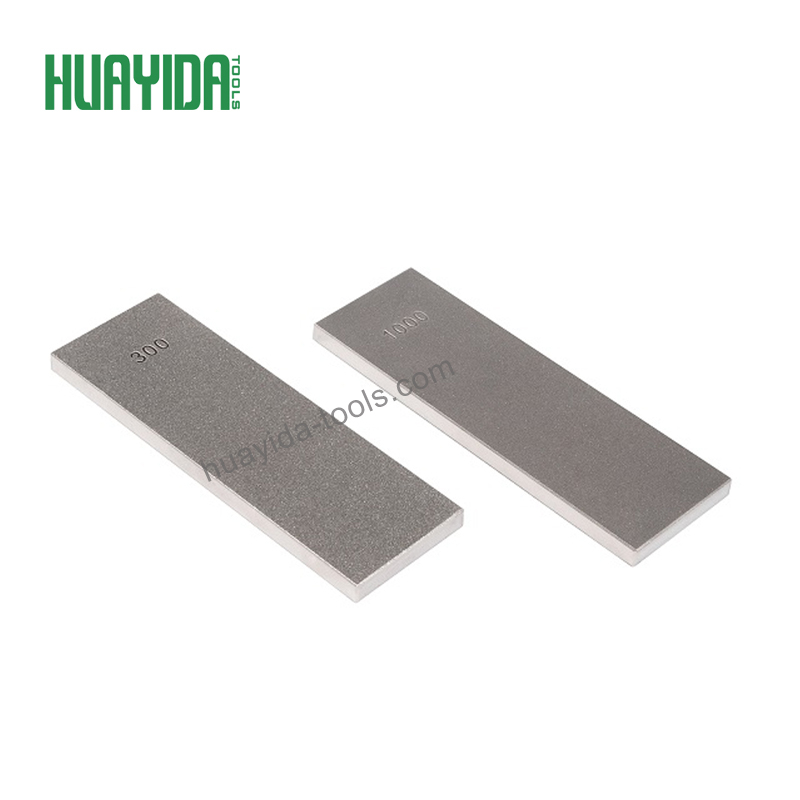
6 × 2″ bench pro diamond sharpening whetstone
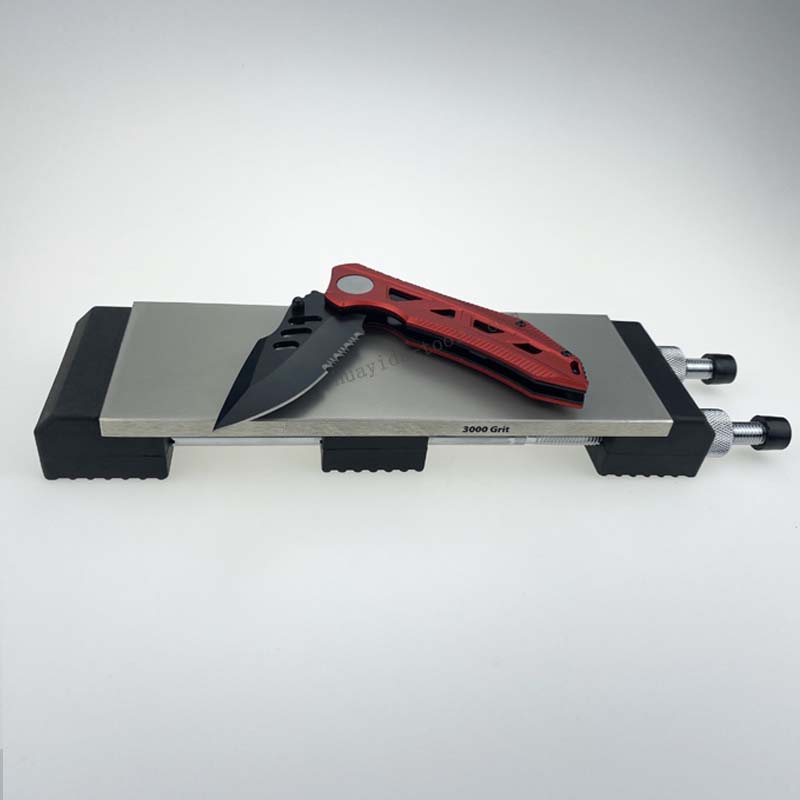
8 × 3″ extra fine diamond stone
Below are some of the leading diamond whetstone sets that are well-suited for professional sharpeners or high-end users. I've grouped them by origin or style to make comparison easier.
DMT is a well-known American brand in the diamond sharpening industry. Their Dia-Sharp (continuous diamond surface) and DuoSharp (interrupted pattern) lines are respected.
The DMT Double-Sided 11½" Dia-Sharp Kit combines two stones with four grits (e.g. extra-coarse, coarse, fine, extra-fine) on two plates, offering broad coverage.
They are precision-ground for flatness and are built with robust construction, making them a strong candidate for professionals.
Downsides: higher price, more expensive shipping (due to USA origin), limited custom OEM options.
Brands like Lansky (or small specialty sharpening brands) produce multi-stone kits, detachable plates, or modular systems. These are often more boutique, but valued for quality and brand prestige, which can help in resale or premium offerings. They may also support limited OEM co-branding in some cases.
Japan has precision manufacturing in sharpening tools. Some Japanese makers produce ultra-flat diamond bench stones, often for high-end kitchen or woodworking markets. These are usually premium in cost but prized for performance, especially in niche sharpening or cutlery workshops.
This is often where value lies for wholesale buyers. Some good examples:
HUAYIYDA’s own sets (multi-grit kits combining coarse, medium, fine, ultra-fine) with OEM labeling.
Generic or semi-branded Chinese kits that bundle 3–6 diamond plates in a carrying case, often with a non-slip base or mounting frame (e.g. 9-piece diamond knife sharpening set).
Many Chinese sets adopt common grit progressions (e.g. 200 / 600 / 1200 / 3000) to remain familiar to users.
Because these are factory-level products, margins are better for wholesale buyers. The tradeoff is ensuring consistent quality, checking flatness, and verifying the diamond bond and grit accuracy.
Here’s a sample comparison table (hypothetical / illustrative) you might use when evaluating candidates. You’d fill in real numbers based on samples:
| Brand / Model | Plate Size | Grit Range | Substrate & Thickness | Flatness Spec | Typical Wholesale Unit Price | Lifetime Estimate | OEM / Branding Support |
|---|---|---|---|---|---|---|---|
| HUAYIYDA 4-pc kit | 3″×1″ plates | 200 / 600 / 1200 / 3000 | Steel backing, 3 mm | ±0.02 mm | $8–$15 per set | ~10,000 passes | Yes (logo, packaging) |
| DMT 11½″ Dia-Sharp Kit | 11½″ × 2½″ | 220 / 325 / 600 / 1200 | Nickel-bond on steel | ±0.01 mm | ~$250 retail / lower wholesale | Very high | Limited / none |
| Japanese bench stone | 8″ × 3″ | 600 / 1200 / 2000 | Aluminum / steel plate | ±0.01 mm | Premium tier | High | Possibly co-branding |
| Generic Chinese 6-pc | 2″ × 1″ | 120 / 400 / 600 / 1000 / 2000 / 3000 | Steel backing | ±0.03 mm | $6–$12 | Good | Yes |
You’d use such a table to compare speed (cutting rate), life (how many uses before performance drops), consistency, and branding options. Always request samples and test them under your expected workload.
Even the best diamond plates require care. Here are best practices to extend life and maintain performance.
As you sharpen, metallic particles and filings embed or clump; wash the plate frequently with water.
Use a soft brush or mild detergent to dislodge particles (avoid harsh acids or salts).
Dry thoroughly (especially steel backing) to prevent rust.
Even diamond plates will gradually lose their perfect flatness. Use a fine lapping plate or precision lapping film periodically.
Some pros set a schedule: e.g. “lap every 100–200 hours of use.”
Use only flat lapping tools, avoiding curved sandpaper methods that introduce concavity.
Many diamond plates are designed to work dry or with water to cool the surface and carry away debris.
Use clean water or mild coolant; avoid salts or harsh chemicals.
Do not over-soak; the substrate (especially if steel) can suffer oxidation.
In high-volume work, occasional misting or a drip coolant system helps maintain edge quality.
If using modular or replaceable-plate systems, swap out worn plates rather than discarding the full set.
Some factories (like HUAYIYDA) may offer re-plating or refurbishment services for worn substrates.
Keep spare plates or a spare full kit to avoid downtime during replacement.
By following good maintenance, you can extend the functional life of your diamond sets by several times beyond typical.
When buying diamond whetstones at scale—especially for professional sharpening services, workshops, or retail distribution—smart sourcing is everything. The right supplier can ensure steady quality, reduce defects, and maximize profit margins. Let’s look at the key sourcing considerations in detail.
Before committing to a large wholesale order, evaluate your supplier thoroughly:
Experience and certifications: Look for manufacturers with ISO quality certifications or export experience. HUAYIYDA, for instance, has decades of manufacturing expertise and exports to multiple markets, giving buyers confidence in their QC systems.
Sampling policy: Always request physical samples to test grit uniformity, adhesion quality, and flatness. The best suppliers—like HUAYIYDA—often offer free or discounted samples before bulk orders.
Production capacity: For larger orders (e.g., 10,000+ units), ensure the supplier can maintain consistent quality at volume.
Customer references: Ask for past customer feedback or case studies. Reliable suppliers are transparent about their clients and performance.
Minimum Order Quantity (MOQ): Most factories have MOQs ranging from 200–500 sets for custom orders. HUAYIYDA offers flexible MOQs for branded or unbranded products, making it easier for smaller wholesalers to start.
Branding options: OEM/ODM capabilities are vital. You can add your logo, packaging design, grit labeling, or color schemes to differentiate your brand.
Packaging: Strong retail packaging (magnetic boxes, EVA foam inserts, anti-slip trays) adds perceived value.
Shipping considerations: Shipping costs can be reduced through bulk sea freight, but factor in lead times (usually 25–40 days). Express options like DHL or FedEx are faster but more expensive.
Implement a simple QC workflow:
Sample testing — Test performance on various steels and measure flatness using feeler gauges.
Pre-production approval — Sign off on a “golden sample” before bulk production.
In-line inspection — Random checks during manufacturing to ensure consistency.
Final inspection — Spot-check finished goods for grit accuracy and labeling.
You can hire third-party inspection companies like SGS or Bureau Veritas in China to confirm specs before shipment.
Unfortunately, the sharpening tool industry—like many others—has counterfeit or “over-marketed” diamond stones that don’t meet their labeled grit or diamond density.
To avoid that:
Always source directly from verified factories such as HUAYIYDA instead of middlemen.
Use sample verification for every order batch.
Avoid extremely low-cost offers—if a “diamond plate” costs under $3 retail, chances are it uses minimal diamond coating or uneven plating.
By investing in a vetted manufacturer, you protect both your brand and your customers’ satisfaction.
To better understand how professionals leverage diamond whetstone sets, let’s explore three real-world applications that show their value and ROI.
In knife manufacturing plants or industrial maintenance departments, sharp edges are mission-critical. Technicians use diamond stones to maintain blades for:
Food processing equipment
Paper and textile cutting blades
Metal shears and industrial knives
Using HUAYIYDA’s 4-piece diamond set (240 / 600 / 1200 / 3000 grits), these teams reduce sharpening time by 40–60% compared to traditional stones, while maintaining consistent results. The ability to quickly switch between grits ensures minimal downtime—an essential factor in production efficiency.
Carpenters, joiners, and tool restorers use diamond stones for flattening plane blades, chisels, and carving tools. Unlike water stones, diamond plates don’t hollow out, keeping edges precise.
HUAYIYDA’s 8×3″ double-sided 400/1200 grit plate is particularly favored here—it combines two core grits in one tool, saving bench space and allowing for rapid progression sharpening. Its high diamond concentration helps restore even heavily nicked blades in minutes.
In woodworking communities, this combination of efficiency and reliability has made diamond stones a must-have upgrade over traditional abrasives.
In outdoor supply businesses and professional cutlery shops, compact diamond stones offer portability and performance. Small 3″×1″ plates or folding diamond sharpeners fit easily into kits for on-the-go use.
Wholesale buyers often bundle HUAYIYDA’s mini-plates (in assorted grits) into multi-pack retail sets, adding excellent resale value. These sets are perfect for hunters, chefs, and outdoor enthusiasts—giving professionals a way to offer durable, field-tested sharpening tools.
The diamond sharpening industry continues to evolve. Here are some innovations shaping the next generation of whetstones:
Advanced nano-diamond technologies are making plates smoother yet sharper, reducing scratch depth while maintaining cutting speed. This gives users mirror-polished finishes with fewer grit transitions. Some R&D from Chinese factories (including HUAYIYDA’s latest lines) explores nano-layered plating for ultra-fine grits above 4000.
Hybrid stones combine ceramic or resin-bonded substrates with diamond layers for improved feedback and smoother tactile feel—ideal for chefs who prefer a “water-stone feel” with diamond efficiency.
Flexible diamond sheets or magnetic-backed plates are trending. They let users swap surfaces quickly and reduce replacement costs. Some pro systems now integrate adjustable jigs, laser-guided bevel angles, and app-based tracking for precision sharpening.
With the rise of smart workshops, diamond abrasives are being integrated into automated blade-sharpening robots and CNC systems. These require consistent grit calibration—another reason why reliable manufacturing (like HUAYIYDA’s controlled plating process) matters.
When selecting a diamond whetstone set—whether for professional use or wholesale distribution—the balance of performance, durability, and cost-efficiency defines success.
Top-tier brands like DMT and Japanese precision stones excel in consistency and finish but come at premium prices. On the other hand, HUAYIYDA (Huayida Tools) delivers an excellent middle ground: reliable diamond bonding, flatness control, broad grit range, and competitive wholesale pricing.
For wholesalers and pro sharpeners, the best approach is:
Start with sample testing from 2–3 factories (including HUAYIYDA).
Evaluate grit accuracy, cutting speed, and longevity.
Build relationships with suppliers offering OEM flexibility and after-sales support.
A properly sourced diamond whetstone set isn’t just a sharpening tool—it’s an investment in productivity, brand reputation, and customer satisfaction.
Diamond whetstones are faster-cutting, stay flatter longer, and need less maintenance. They can handle hard tool steels that water stones often struggle with.
With proper care, a high-quality plate (like those from HUAYIYDA or DMT) can last several years, even under daily use. Regular cleaning and gentle handling extend lifespan.
Most are designed for water or dry use only. Using oil may clog the abrasive surface. Always check manufacturer recommendations.
Yes. HUAYIYDA offers flexible MOQs and OEM options, making it ideal for startups or retailers wanting to brand their sharpening products.
A 4-stage system (e.g., 240, 600, 1200, and 3000 grits) covers repair, sharpening, refining, and polishing needs for almost any blade.


